
Calacus Sports Comms Monthly – Sydney Sweeney & Novig
Every month we look at the best and worst communicators in the sports world from the last few weeks.
SYDNEY SWEENEY & NOVIG
Sydney Sweeney knows that her appearance has commercial value and how to monetise it.
That observation may sound crass, but the entertainment industry has always reduced people to marketable characteristics - and whatever people claim to use fame for empowerment, entrepreneurship and personal branding, physical beauty remains a powerful currency.
It’s spanned generations, from the days of Jane Russell, Marilyn Monroe and Raquel Welch, to Madonna making provocation part of her business model and Kim Kardashian building an international business by taking greater ownership of the process.
Sydney Sweeney is the latest to use self promotion to manufacture an image - and now she can communicate directly with millions of people, become an investor in the product being promoted and benefit financially from every argument generated by the campaign.
Sweeney’s controversial campaign for sports prediction platform Novig shows her naked or partially clothed, with strategically positioned balls, rackets and other sporting equipment protecting her modesty.
The message is that Novig concentrates on sport rather than offering markets involving politics, conflict or death.
The execution, however, ensures that almost nobody is talking about that distinction, focusing on whether the advert demeans women’s sport.
Four-time Olympic swimming champion Ariarne Titmus condemned the campaign, while British sprinter Amy Hunt used a post-race interview to contrast its imagery with the pain, muscle, sacrifice and physical realities of elite competition. Boxer Skye Nicolson argued that there was an important difference between a sportswoman looking attractive and a company using sexual imagery to market a sporting product.
Women have spent decades demanding the right to be valued for their performances rather than their appearance. Even the most senior leaders in sport have sometimes struggled to understand that.
In 2004, then FIFA president Sepp Blatter proposed that female footballers might attract more interest by wearing more feminine clothing and tighter shorts.
The suggestion exposed an assumption that women’s football couldn’t sell itself through skill, drama, personality and competition.
Similar attitudes have shaped sporting dress codes.
The International Volleyball Federation changed its regulations ahead of London 2012 to allow female beach volleyball players to wear shorts and sleeved tops. The change was intended to accommodate different cultural and religious expectations and encourage more countries to participate.
In 2021, Norway’s women’s beach handball team were fined after wearing shorts instead of the bikini bottoms prescribed by the regulations and thankfully the rules were eventually altered following the outrage of international reaction.
That history helps to explain why so many athletes found Sweeney’s advert infuriating, another example of sporting imagery being used to present women as decoration.
There is, however, a crucial complication.
Sweeney is not an athlete being forced into revealing clothing by a governing body. Nor is she a performer apparently following instructions from a powerful studio executive because it was revealed that she’s actually a Novig investor and strategic partner.
According to Novig chief executive Jacob Fortinsky, Sweeney approached the company about working together and helped to develop the campaign.
It’s therefore difficult to portray her as someone who has been manipulated into participating, because she made a choice and appears likely to benefit from it.
Sweeney is entitled to use her image in any lawful way she wishes, but you can’t blame athletes for objecting when the imagery of their sports is used to frame a naked celebrity for a campaign largely aimed at male gamblers.
Neither position invalidates the other.
Sweeney responded to the criticism by sharing photographs of famous athletes who had posed naked for magazine shoots, including Serena Williams, Megan Rapinoe and Sue Bird.
It was an understandable response, but it overlooked an important distinction.
A photograph of an athlete can celebrate the extraordinary body created through training and competition, revealing strength, vulnerability and the physical consequences of sporting excellence.
The Novig advert was not examining Sweeney’s relationship with sport or celebrating an athletic achievement but using sporting equipment to turn nudity into a visual joke and connect it to a prediction business.
There’s nothing inherently wrong with being sexy. or with an athlete embracing glamour or femininity.
The objection is not that women must choose between strength and attractiveness, rather that the concern is that women’s bodies still seem capable of generating more attention around sport than women’s performances.
That remains a serious issue when female athletes continue to fight for coverage, sponsorship and commercial recognition.
The Guardian reported that the Novig video received more than 22 million views during its first two days, far more than many outstanding performances in women’s sport have received.
Of course, that’s precisely why Novig commissioned the campaign.
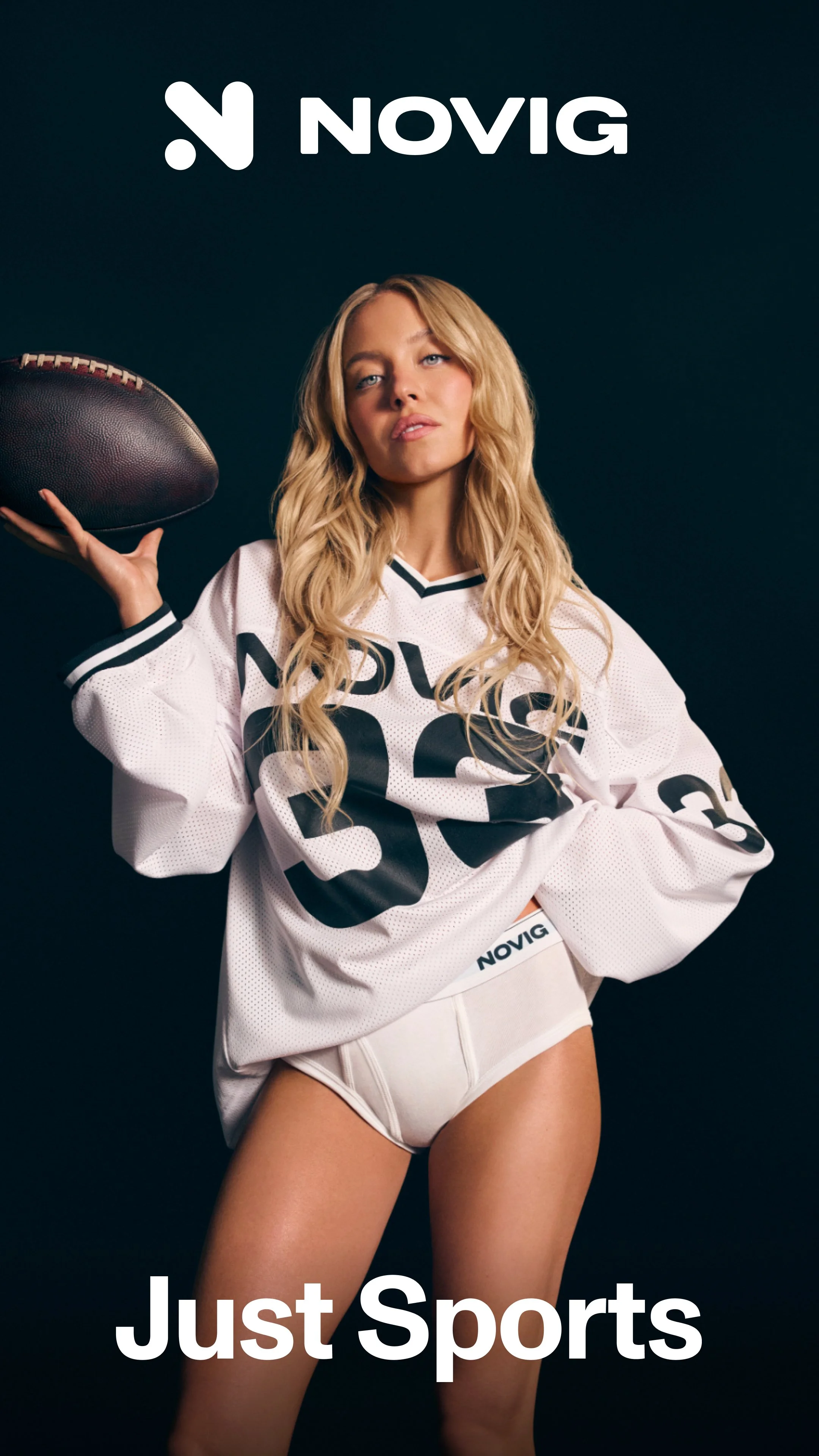
The company is competing against larger and better-known prediction platforms, so hiring one of the world’s most discussed actors and placing her in an advert guaranteed to divide opinion was an effective way to introduce its name to millions of potential customers.
Data reported by Business Insider showed that Novig’s social media mentions increased more than ninefold following the launch, although only four per cent of the relevant posts concentrated on the app.
Novig’s promise to avoid predictions involving death, wars and politics offers a potentially interesting ethical position, differentiating the company from platforms willing to let customers trade on deeply troubling real-world events.
The campaign unquestionably created attention, but whether it established a clear and durable identity and commercial value for Novig is another matter.
A recognisable name is valuable, particularly for a challenger business, but will it remain associated with a naked celebrity once the controversy subsides and customers must decide whether they trust the product.
The company may not care. Its immediate objective was evidently to secure attention before the American football season, and it achieved that. But good communications should do more than make people look - it should help them understand what the organisation offers and why they should choose it.
Sweeney reportedly lost more than 200,000 Instagram followers after the advert appeared, which may sting despite her 25m audience.
She may conclude that the exchange was worthwhile, surrendering a fraction of her following while gaining international publicity and promoting a company in which she owns a stake.
My concern is less about whether Sweeney should be allowed to use her sexuality and more about what that causes for female athletes wanting to have their sport taken seriously, as well as the wider impact on women’s sport.
Women’s sport is working to establish its own commercial identity, increase attendances, secure stronger broadcast agreements and persuade sponsors to invest for the long term. Its growth depends on audiences recognising the quality of the competition and developing genuine connections with its athletes, teams and stories.
Campaigns such as this risk pulling the conversation backwards. When one of the most prominent sports-related adverts of the year uses a woman’s body as its central creative device, it reinforces the assumption that women remain most valuable to sport when they appeal sexually to men.
That influences which images receive attention, what content algorithms reward and how potential sponsors assess the market. If sexualised campaigns consistently attract more coverage than outstanding performances, brands may continue to view women’s sport as a lifestyle or entertainment accessory rather than a credible commercial property in its own right.
The response from Ariarne Titmus, Amy Hunt, Skye Nicolson and others was therefore not simply an attack on Sweeney’s choices. It reflected frustration that athletes are still required to explain why strength, rivalry, skill and sacrifice should be enough to make women’s sport compelling.
There is also a burden in expecting athletes to correct the message. They shouldn’t have to publish training footage, display their medals or recount the physical realities of competition to remind audiences what women in sport actually do. Their performances should provide the answer.
The impact also reaches grassroots sport with young girls still deciding whether they belong, while boys are forming their impressions of female athletes. If major campaigns repeatedly present women as decoration around sport, it becomes harder to persuade the next generation to regard them first as competitors.
Novig may argue that the campaign wasn’t intended to represent women’s sport, but communications don’t work so neatly. A company can’t borrow the imagery, equipment and cultural authority of sport and then deny responsibility for the message audiences take from it.
The advert generated attention for Novig, but female athletes and women’s sport were left carrying much of the cultural cost. That should concern every governing body, sponsor and communications professional trying to build the sector sustainably.
The question is not whether sex still sells. The question is why sport continues to believe that a woman’s body is a safer marketing proposition than women’s sporting achievement.