
Calacus Sports Comms Monthly – Infantino turns the tide
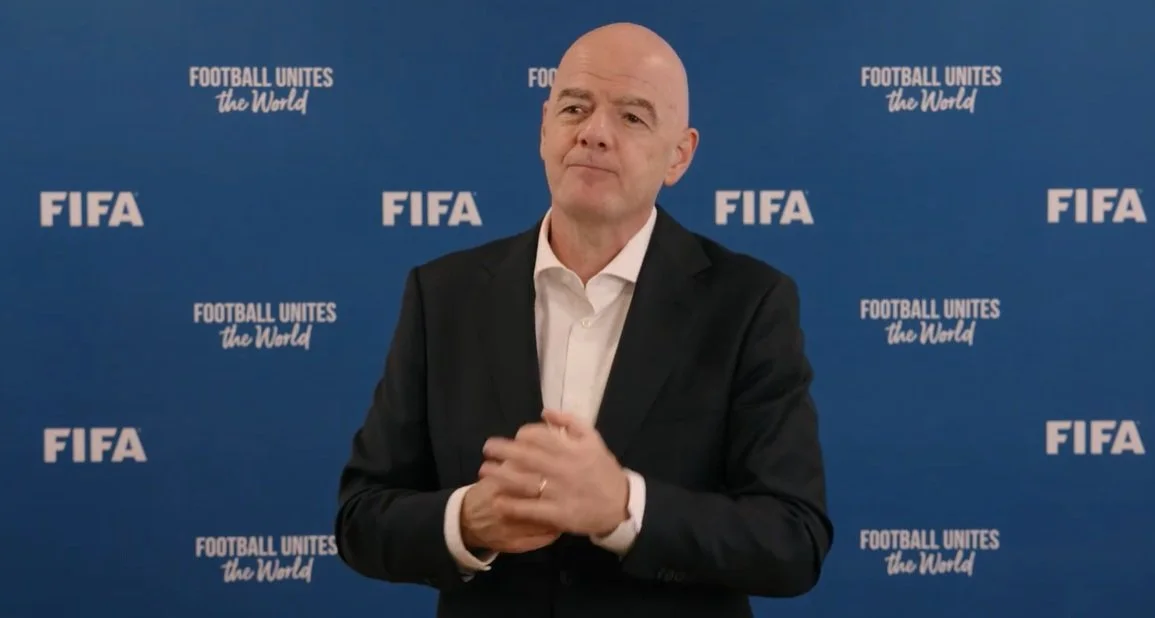
Gianni Infantino laughed when he was asked whether he had considered resigning as FIFA president.
In August, when three of football’s most powerful confederations accused him of breaking trust “through deception,” such confidence might have appeared misplaced.
Now it feels more like the response of a politician who has counted the votes, neutralised much of the opposition and concluded that the danger has passed.
The crisis began with FIFA Forward Enterprise, a proposal to transfer the commercial and ticketing rights of FIFA competitions into a new company and sell a minority stake to private investors. The project was abandoned after fierce opposition, but the damage came from more than its commercial implications.
UEFA, Concacaf and the Asian Football Confederation accused Infantino of excluding FIFA’s Council and member associations from the process, attempting to accelerate approval and treating the World Cup as though it were his asset to sell.
Their joint intervention was unusually personal and direct, describing the proposal as a “profound failure of judgement” and accusing Infantino of placing himself above the collective that had entrusted him with authority.
Preliminary discussions reportedly took place over alternative competitions if members boycotted FIFA tournaments, while several national associations withdrew their support and pressure grew for Infantino to leave with dignity rather than seek another term.
The controversy soon expanded beyond FIFA Forward Enterprise. Reporting reached back into Infantino’s time as UEFA general secretary, with allegations that European football’s governing body had made a six-figure departure payment to a woman with whom he was alleged to have had a relationship.
Infantino strongly denied the claims, describing them as categorically untrue, while UEFA confirmed that a departure payment and MBA fees had been provided but maintained that these complied with the regulations in force at the time.
However legitimate the public-interest questions surrounding senior officials may be, the intervention dragged Infantino’s personal life into a political battle over FIFA’s governance. It also presented him with the opportunity to argue that the scrutiny had become a campaign to remove him rather than an effort to establish what had happened.
That argument gained further credibility when The Times corrected and apologised for reporting that he had received an undisclosed “second salary” and acquired a Miami property at a suspected cut price. The newspaper accepted that there was no second salary and that neither Infantino nor his family owned or controlled the company linked to the property.
The correction didn’t resolve the substantive questions about FIFA Forward Enterprise, Infantino’s relationship with Donald Trump or the concentration of power within FIFA, but it gave his communications team something extremely valuable: evidence with which to blur the distinction between justified investigation and inaccurate accusation.
FIFA responded by claiming that a “concerted and ongoing effort” was being made to undermine the organisation and its president. Once some allegations were shown to be wrong, it became easier to cast doubt upon the motives behind others.
Infantino then did what he has always done exceptionally well. He went travelling to meet federation leaders and cement his support base.
Morocco, the Dominican Republic, Cape Verde, Japan and Azerbaijan became stops on a political charm tour where the FIFA president met national associations, emphasised development funding and reminded football’s smaller nations that they possess exactly the same vote as England, Germany, France or the United States.
His argument was positioned as one of democracy and inclusion, but its effectiveness rested upon a much more practical understanding of how FIFA elections are won.
Every member association has one vote, irrespective of the size of its population, commercial market or football economy. UEFA may dominate the game’s revenues and stage the highest profile competitions, but it controls only 55 of FIFA’s 211 votes. Africa has 54, Asia will have 46 at the election, Concacaf has 35, Oceania 11 and South America 10.
Infantino doesn’t have to win the argument in Europe if he can retain the confidence of associations elsewhere.
The decisive moment came in Cape Verde, where Africa’s 54 associations offered what was described as unconditional support for his re-election. Infantino promised further resources for African football and highlighted that FIFA Forward had invested more than $1 billion across the continent during his presidency.
A few weeks later in Tokyo, AFC president Sheikh Salman bin Ibrahim Al-Khalifa completed an extraordinary reversal by endorsing Infantino for another term, despite having signed the August letter accusing him of a fundamental breach of trust. reuters.com
Sheikh Salman acknowledged that there had been problems but declared that it was time to “move forward”, while Infantino responded by praising his leadership and promising FIFA’s continuing support.
Sheikh Salman had also been appointed to chair a committee examining FIFA governance reform, which may be entirely defensible, although it creates the impression that confrontation has been replaced by accommodation at precisely the moment both men are seeking renewed mandates.
Money is central to the political machinations, even if there is no evidence that development funding has been made conditional upon electoral support. Infantino has proposed increasing the amount available to every member association during the next four-year cycle from $10 million to $25 million, lifting the total distribution by approximately $3.4 billion.
For smaller associations struggling to fund pitches, academies, competitions, women’s football and national teams, that is not an abstract promise. It is potentially transformative.
Critics will inevitably describe the timing as electioneering, while Infantino can reasonably argue that FIFA earns enormous sums and should distribute more of them to the organisations responsible for developing the game.
Both interpretations can be true. Funding football is one of FIFA’s central responsibilities, but the person announcing unprecedented distributions shortly before an election also receives considerable political benefit from doing so.
Concerns have not disappeared, though. UEFA has submitted 42 questions covering FIFA Forward Enterprise, the FIFA Peace Prize awarded to Trump and other decisions, demanding answers and supporting documents by November 2.
England FA chair Debbie Hewitt has said that Infantino must provide the requested information, while German FA president Bernd Neuendorf believes meaningful reform is impossible without a “complete restart.”
Yet opposition without a candidate is a protest rather than a campaign. UEFA and Concacaf helped create the most serious challenge Infantino has faced since taking office in 2016, but they have so far failed to identify a credible alternative capable of appealing beyond Europe. With nominations closing on November 18 and the election taking place in March, time is rapidly disappearing.
Infantino hasn’t necessarily changed many minds about the failures of the summer, but he has persuaded enough people that their interests are better served by continuity than confrontation, while the AFC reversal has shattered the appearance of a united international rebellion.
Africa and Asia together take him close to the majority required before support from South America, Oceania or individual Concacaf nations is considered.
Infantino has the confidence of a consummate football politician who understood that outrage in London, Frankfurt or Nyon wouldn’t decide his future.
The election will be determined in 211 national associations, and Infantino has spent the autumn ensuring that enough of them remember what FIFA provides, what he is promising and who controls its distribution.
He hasn’t yet ended the arguments about his leadership but right now, few would bet against him securing another term after proving that critical media coverage can be overcome by understanding the politics of nations.