
Calacus Monthly Hit & Miss – Ian Wright and Jude Bellingham
Every month we look at the best and worst communicators in the sports world from the last few weeks.
IAN WRIGHT & JUDE BELLINGHAM
The pressure of playing for the England national football team is unrelenting.
The country that gave football to the world has only won the World Cup once, and two recent EURO final disappointments have continued the frustration of fans desperate for glory.
When David Beckham was the golden boy of English football, one leg flick against Argentina in the 1998 World Cup led to months of vilification, effigies and abuse from media and fans alike that must have made life tough for the young winger.
More recently, though, the focus of abuse from the media has been very much focused on England’s black players, especially after three of them missed penalties in the EURO 2020 final at Wembley that the home nation went on to lose to Italy.
Marcus Rashford, who has done so much to help under-privileged children during the Covid-19 lockdowns and beyond, has been a constant focus of media scrutiny.
We wrote some time ago about the mid-market tabloids highlighting his spending habits as if he was being extravagant, the undertone that a young black man should know his place and be more humble.
Bukayo Saka was another who was targeted, even being the focus of imagery on the back pages for an embarrassing defeat against Iceland where he only appeared as a late substitute.
The latest target for the media’s sights is Jude Bellingham.
When the midfielder left hometown team Birmingham City, the club retired his number 22 shirt number, and after three excellent years at Borussia Dortmund, he moved to Spanish giants Real Madrid for more than £100m.
His first season in Spain was incredible, scoring on his La Liga debut, scoring in El Clasico home and away as Madrid won the domestic title, and then had an assist in the Champions League final victory over Dortmund to cap a memorable first campaign.
He won the 2023 Golden Boy as the best under-21 player in Europe and La Liga Player of the Season, as well as coming third in the Ballon D’Or.
For someone so young to thrive in a foreign league, let alone star for or one of the biggest clubs in the world takes a strong mentality, and one which has seen Bellingham punished for his competitiveness.
He was sent off in his debut season after complaining to the referee, who had inexplicably blown the whistle just as Bellingham scored what would have been the winner in a 2-2 draw with Valencia.
Fast forward to the summer of 2025 and new England manager Thomas Tuchel gave the tabloids more to feed on when he said that his own mother found Bellinghma’s on-field attitude “repulsive.”
Sadly, the media need little encouragement to target a player, particularly a black player, when criticism has come their way.
Tuchel went on in that interview to say: “"He has the fire and I don't want to dim this down. He should play with this kind of fire, that's his strength. But the fire comes also with some attributes that can intimidate you, maybe even as a team-mate.
"You see sometimes the explosion towards referees and the anger in his game, so if he can channel this in the right way and we can help him in this, then for sure he has the something that we need and he has a certain edge that is hard to find."
As a native German, it’s fair to suggest that Tuchel’s use of language was perhaps clumsy rather than malicious, something that prompted an apology a short while later.
Tuchel lamented: “I used this word unintentionally, just to make it very clear. There was no message. There was no hidden agenda. I fully understood and understand that it's my responsibility that I created these headlines. I am sorry for the upset and I am sorry for the headlines I created.
"I am experienced enough and should've known better, I should've done better. I thought I had a little more credit with you guys (media) that I do all this in my second language. I did it the morning after a loss, with not a lot of sleep, in a live interview, and I used the wrong word. Again, it's my responsibility."
Yet certain elements of the British media have carried on targeting Bellingham, especially since his once nailed-on place in the England first team is now less secure following the development of Morgan Rogers.
After he was substituted in the final qualifying game against Albania, Bellingham waved his arms harmlessly, understandably frustrated to be coming off.
One Daily Mail journalist has written extensively about “Bellingham’s petulance” and questioning whether he should even be in the England squad to the point where it appears to be a focused campaign.
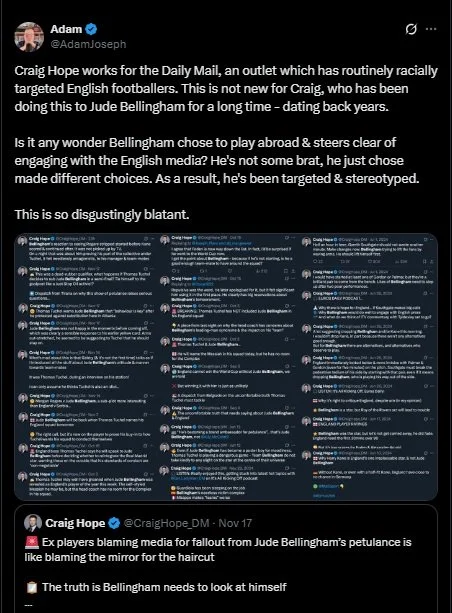
As often is the case, Ian Wright, the former Arsenal and England forward, spoke out in defence of Bellingham, saying what many have been thinking, that there is more than a hint of racism to the criticism.
He commented: "I'm worried for Jude simply because he's somebody that they [the media] can't control," said the Arsenal legend on The Overlap YouTube channel.
"He's showing people that I'm here, I'm black, I'm proud, I'm ready to go. I don't think they're ready for a black superstar, who can move like Jude is moving. They can't touch him.
"He goes out there, he performs, he does what he does. It's too uppity for these people. I'll put it in football terms. They all love N'Golo Kante. He's a humble black man, gets on with what he's doing.
"But if you get a [Paul] Pogba, or a Bellingham, and you get that kind of energy, that does not sit well with people. So someone like Jude, for some reason, frightens these people because of his capability and the inspiration he can give."
Others have backed him too – including Rio Ferdinand, who pushed back on the idea that frustration at being substituted is uniquely scandalous. “Baffled – no big player wants to be taken off,” he said on X.
Of course, footballers should not be above criticism, and frustration on or off the pitch, when England’s matches have been mostly straightforward gives the media the column inches they desire.
Notably, former Real Madrid coach Carlo Ancelotti, who is used to dealing with big name players, expressed his support for Bellingham.
He said: “No, I never had a problem with Jude about his attitude. He is really professional, really serious, works hard in training, like all English players do. And no, no complaints.”
When there’s no crisis, no drama, one gets invented. A player becomes the story because there’s little else to say – and Bellingham’s innocuous frustration was all they had.
And the framing of it does matter – as Wright pointed out, the confidence, the competitiveness, the focus that Bellingham exhibits discombobulates his detractors.
It’s hard to ignore the fact that black footballers are celebrated when they are seen to be humble, quiet or just grateful to be there, but any sense of ambition is quickly seized upon.
International football is a communications pressure-cooker, with fewer games, stronger emotions and bigger symbols, the epitome of a soap opera with shin pads.
Raheem Sterling called out the double standards in coverage of black players in 2018, accusing newspapers of “fuelling racism” through portrayals that place “the young black kid… in a bad light.”
Nothing seems to have changed since Sterling’s rightful protestations.
When Wright says he’s worried, it’s not melodrama – it’s lived experience of how quickly debate can become abuse and how easily black athletes become acceptable targets once the storyline gives permission.
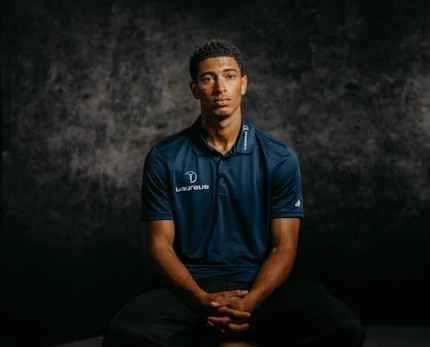
To his credit, Bellingham is handling all this with more emotional intelligence than most of those criticising him.
On World Mental Health Day, he put it plainly: “There’s enough negativity and pressure in professional sport that you don’t need to seek it out.”
He’s not sought out a friendly journalist to address the criticism, nor posted on socials, to show the world that this does not bother him. He’s letting his football do the talking.
Even Tuchel tried to dismiss the story, playing down the substitution reaction and emphasising team respect and said: “"I saw that he was not happy. I don't want to make it bigger at the moment than it is.
"I think to a certain degree if you have players like Jude, who are so competitive, they will never like it, but, as you said, my word stands.”
Whether progress can be made, both in the media and in society, remains to be seen. History suggests we have a long way to go to treat white and black sports stars alike.
Regardless of whether certain sections of the media and society like it or not, Bellingham’s success on and off the field will endure – and has made him the superstar he has become today.
Esteemed football writer Henry Winter summed it up perfectly when he said: “Crazy that this has to be again but here we go again. We should be proud that English football has produced a special talent (hat tip to Birmingham City) who’s gone abroad and now stars for the biggest club in the world.
“Bellingham shines in a Real spotlight that can feel like a real searchlight to some. For clubs and country, Bellingham embraces pressure in challenging games. I’ve seen pile-ons on Barnes, Gascoigne, Beckham, Rooney, Sterling and Rashford, when objective criticism crosses the line into hounding.
“It’s happening with Bellingham. It’s a myth that Bellingham is simply about himself. Any fair-minded observer can see the work he does out of possession, tracking back, tackling, covering for others.
“He has a competitive edge that England need. It’s one of his great strengths, that mindset. So, some perspective and balance is required here. Bellingham wants to play. Because for England to have a momentous 2026, they need Jude Bellingham. It’s foolish to think otherwise.”